
Sunset couples travel · Los Lagos, Chile
Chile’s second largest lake —860 km²— mirrors the near-perfect cone of Volcán Osorno every dusk. A romantic escape that combines volcanic wilderness, a 186 km scenic drive, German heritage towns and quiet lakeland shore.
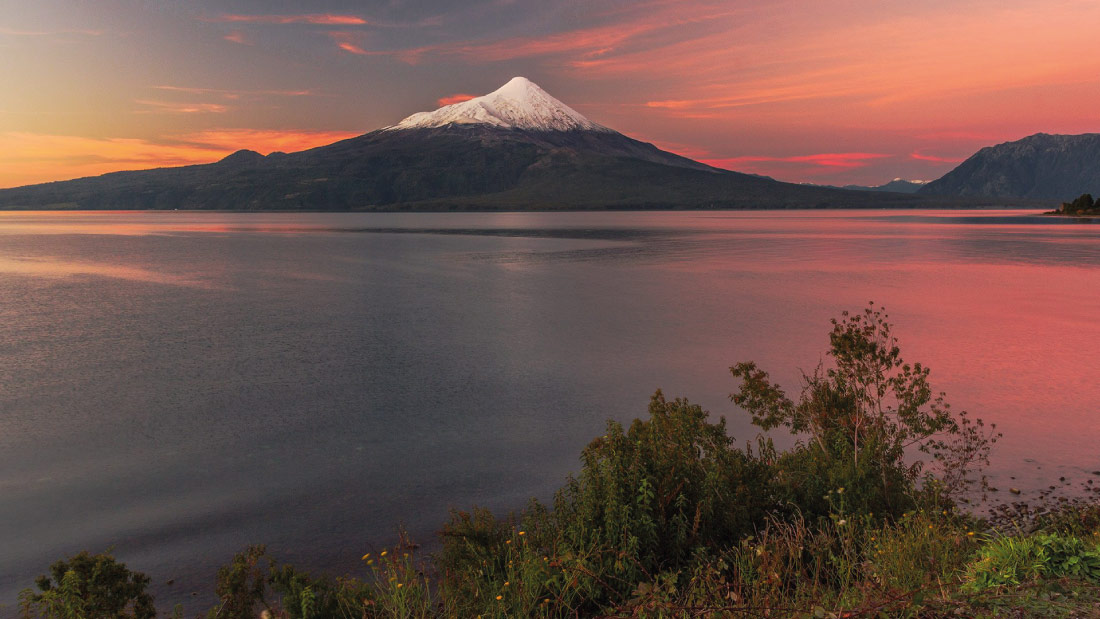
Southern Chile holds one of the most quietly dramatic settings in the lakeland of the Andes: an 860 km² lake whose Mapuche name, llanquyn-we, means “sunken place”. Lago Llanquihue sits at 70 m above sea level and reaches a maximum depth of 317 m, making it the second largest lake in Chile. On calm evenings its blue surface mirrors the near-perfect cone of Volcán Osorno (2,652 m) and the broader silhouette of Volcán Calbuco (2,016 m). For couples who travel for landscape and silence rather than for nightlife, this is hard to beat.
The lake is the heart of the Chilean Lake District — a string of small towns on the shore that inherited German settler architecture from 19th-century colonisation, all linked by a 186-kilometre scenic road. There is no need to organise a multi-day expedition: landing in Puerto Montt puts you within two hours of the cordillera, the volcanoes and a sunset that arrives straight from the Pacific.
Wilderness with a volcanic horizon
What sets Llanquihue apart from other romantic lake destinations is how the wilderness is never far from comfort. The shore road leaves Puerto Varas heading east towards Ensenada and crosses the lava field of the 1835 eruption — still visible as black rock that flows all the way to the water. From there the road enters Parque Nacional Vicente Pérez Rosales, Chile’s oldest national park, where the water of Lago Todos los Santos turns emerald under the cordillera. Hidden beaches along this stretch — Playa Hermosa, Niklitsch, Punta Cabras, Poza Loreley — hold the lake’s most pristine corners, with native forest coming down to the shore and no buildings interrupting the view of Osorno. At dusk the volcano glows pink for a few minutes before the light collapses into deep blue.
A 186-kilometre scenic drive, done slowly
The full circuit around the lake — locally known as la vuelta al lago — is 186 km, more than half of it paved, and can be driven in either direction from any of the four shore towns: Puerto Varas, Frutillar, Puerto Octay or Llanquihue. For a romantic escape, two easy days work better than one:
- South-eastern arc (Puerto Varas → Ensenada → Saltos del Petrohué): the lakeland narrows to viewpoints over the Osorno, lava fields, waterfalls and trails inside Parque Nacional Vicente Pérez Rosales.
- Northern shore (Frutillar → Puerto Octay): only 28 km and 20 minutes behind the wheel, but the quietest side — Bahía Centinela, Península Centinela, Playa Maitén and the wetlands where the Río Maullín begins.
Fill the tank in Puerto Varas, Frutillar, Llanquihue or Puerto Octay (there is also a station in Ensenada), as there are no fuel stations along the 53 km eastern shore between Puerto Octay, Las Cascadas and Ensenada, nor towards Petrohué. The lakeshore roads (CH-225 and U-99-V) are fully paved and open year-round, though winter driving requires caution in heavy rain, morning fog and occasional frost — snow chains are mandatory only when ascending the mountain road to the Volcán Osorno ski centre.
German heritage as an exotic detail
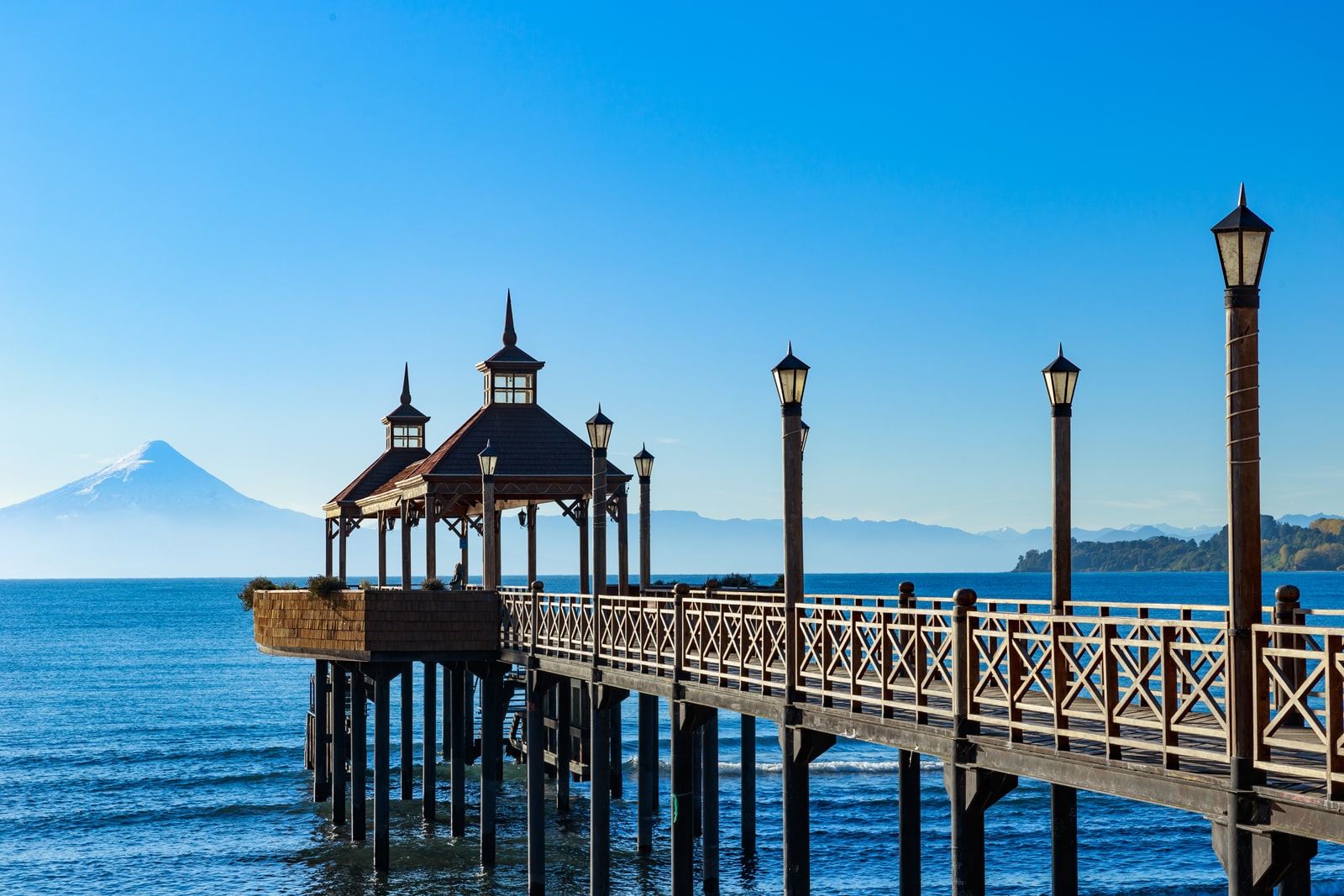
Settlers from Germany arrived here in the mid-19th century, and their wooden houses, shingled roofs and rose gardens still define Frutillar and Puerto Octay. In Frutillar the costanera is lined with century-old German houses, and the Museo Colonial Alemán reconstructs a 19th-century settler homestead with objects donated by local families. The Teatro del Lago, a cultural institution built on the lakefront, hosts classical music each southern summer — a striking counterpoint of European tradition and Patagonian wilderness.
Puerto Octay is even quieter. Its typical zone around the Plaza de Armas preserves Casa Wulf, the San Agustín church and parish house, and the former Casa Emilio Held Winkler, today the public library and settler museum. The shore drives here, with no traffic lights and only the wind off the lake, feel closer to a film set than a tourist town.
When to go and what to bring
The southern summer (December–March) brings long, stable days with sunset after 20:30 and temperatures between 15 and 25 °C. The shoulder seasons (October–November and March–April) trade shorter days for empty roads and autumn colour. Winter (June–September) covers the lower shore with snow and is the most overlooked romantic window — a 75-minute detour from Osorno on the fully paved international CH-215 reaches the Termas de Puyehue geothermal springs inside the national park of the same name (park open daily 09:00–17:30; snow chains are only required further east towards the high mountain pass or the Antillanca ski area). Warm water, cold air and snow on the forest is unforgettable, but bring layered clothing, a waterproof shell and sturdy footwear: weather in the Lake District changes fast in any season.
A romantic escape to Lago Llanquihue is about volcanic sunsets, lakeland silence and a scenic road that asks to be driven slowly. For routes, event calendars and planning tips, visit loslagos.travel.